Beyond Rankings and Impressions: Restructuring Casino Analytics Around the Metrics That Actually Generate Deposits
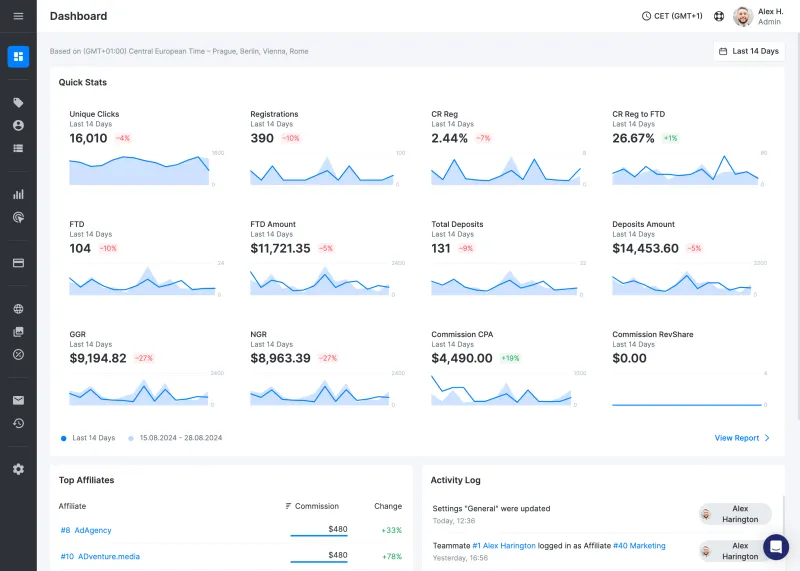
Photo: casino analytics dashboard data metrics conversion funnel digital marketing, via www.scaleo.io
There is a persistent illusion in online casino marketing: that a rising organic traffic curve is equivalent to a rising revenue curve. For operators who have built their reporting infrastructure around keyword positions and session volume, this conflation is not merely an analytical inconvenience—it is an expensive blind spot. The visitor who lands on a slots review page from a broad informational query and the visitor who arrives searching for a licensed New Jersey casino with same-day ACH withdrawals are not the same asset. Treating them as identical units in a traffic report is where the conversion rate ceiling gets installed.
This article is not about abandoning SEO fundamentals. Rankings matter. Crawlability matters. But for US casino operators competing in regulated markets where customer acquisition costs are substantial, the measurement framework surrounding those fundamentals requires a serious recalibration.
The Vanity Metric Trap in Casino SEO
Most casino SEO dashboards are built to answer one question: are we getting more visitors than last month? This framing is operationally comfortable but strategically misleading. A site can increase organic sessions by 40 percent while simultaneously watching its deposit conversion rate erode—because the new traffic is arriving via informational keywords that attract researchers, not players.
The metrics that dominate traditional casino SEO reporting—total organic sessions, average keyword position, domain authority, and backlink volume—are leading indicators of visibility. They are not indicators of revenue. The gap between visibility and revenue is where most operators hemorrhage marketing budget without understanding why their organic channel underperforms paid acquisition.
The correction begins by identifying which micro-conversion signals actually precede a first deposit.
Micro-Conversions That Predict Revenue
A micro-conversion is any user action that meaningfully increases the probability of a downstream revenue event. For online casinos, these signals are specific and trackable—but only if the analytics architecture is configured to capture them.
Account registration initiation rate by landing page. This metric measures what percentage of organic visitors who arrive on a given page begin the registration flow. A page ranking well for a high-intent keyword but generating a sub-two-percent initiation rate is a structural problem—either the page's content is attracting misaligned visitors or the call-to-action architecture is failing to convert interest into action.
KYC and identity verification completion rate. In regulated US markets, account verification is a mandatory friction point. The percentage of users who complete KYC after initiating registration is one of the most predictive metrics for first-deposit probability. Operators who segment this completion rate by organic traffic source consistently discover that certain keyword clusters—particularly those tied to trust signals like licensing, withdrawal speed, or security—produce dramatically higher verification completion rates than generic casino terms.
Time-to-first-deposit for organic cohorts. Not all depositing players are equal in their urgency. Organic visitors who deposit within 24 hours of first session represent a qualitatively different intent profile than those who take seven days. Tracking this cohort separately—and then reverse-engineering which landing pages, keyword categories, and on-page elements correlate with fast-deposit behavior—gives operators a replicable blueprint for content prioritization.
Session depth on transactional pages. A visitor who reads a review page and then navigates to the promotions page, the banking options page, and the game lobby before leaving has demonstrated a multi-step intent signal. Tracking this navigation path as a composite micro-conversion event—rather than counting it as three separate pageviews—reveals which content sequences are functioning as effective conversion funnels.
Rebuilding the Dashboard Around Revenue Correlation
Restructuring an analytics dashboard is a technical and organizational undertaking. It requires alignment between the SEO team, the product analytics team, and ideally the CRM team that manages player lifetime value data. The goal is to create a reporting environment where every organic traffic metric is paired with its corresponding downstream conversion rate.
The practical implementation involves several steps. First, configure goal funnels in your analytics platform that map the complete journey from organic landing page to first deposit, with each intermediate micro-conversion step tracked as a distinct event. Second, create custom segments that isolate organic traffic by keyword intent category—informational, navigational, and transactional—and report conversion metrics separately for each segment rather than in aggregate.
Third, and perhaps most critically, integrate your CRM data with your analytics platform to track player lifetime value back to the originating organic session. This integration is technically demanding but operationally transformative. When an operator can see that visitors arriving via specific long-tail keywords in Pennsylvania generate 3.2 times the 90-day LTV of visitors arriving via broad national casino terms, content investment decisions become substantially clearer.
The Repeat Wagering Signal Most Operators Ignore
First-deposit conversion is the metric most operators optimize toward. It is the wrong finish line. A player who deposits once, wagers through a welcome bonus, and never returns is a net loss in most regulated US markets given current acquisition cost structures. The metric that separates profitable organic channels from expensive ones is repeat wagering rate by traffic cohort.
Operators who track repeat wagering back to organic source consistently find that content addressing ongoing player value—game strategy resources, loyalty program explainers, responsible gaming tools, and banking efficiency guides—generates visitors with meaningfully higher retention rates than content targeting new player acquisition exclusively. This is a content strategy insight that only becomes visible when the analytics framework extends beyond the first deposit event.
Redefining What SEO Success Looks Like
The conversion rate ceiling is not a traffic problem. It is a measurement problem. Operators who continue to evaluate their organic channel through the lens of rankings and session volume will perpetually underinvest in the content and technical optimizations that drive actual revenue, because those investments do not register as wins in a vanity metric framework.
The operators gaining ground in competitive US markets are those who have rebuilt their SEO reporting around the question that actually matters: which organic visitors are most likely to fund an account, complete verification, and return to wager again? Answering that question requires a different dashboard, a different set of metrics, and a willingness to treat organic search as a revenue channel rather than a visibility exercise.